How to Know It a Clamp Meter Is Reading Volts or Amps
Introduction
With technological advances in electric equipment and circuits come more than challenges for electricians and technicians. These advances not only crave more adequacy in today'due south test equipment but more skills on the part of the people who utilise them. An electrician, who has a good grounding in the fundamentals of the use of examination equipment, will exist better prepared for today'southward testing and troubleshooting challenges daily encountered in his/her work. The Clamp Meter is an of import and common tool found in the toolboxes of electricians and technicians akin.

A clamp meter is an electrical tester that combines a voltmeter with a clench-type electric current meter. Like the multimeter, the clamp meter has passed through the analog period and into the digital world of today. Created primarily every bit a single-purpose exam tool for electricians, today'south models have incorporated more measurement functions, more accuracy, and in some instruments, some very special measurement features. Today's clench meters have about of the basic functions of a digital multimeter (DMM), but with the added feature of a current transformer built into the product.
The transformer action
The ability of clamp meters to measure high alternate currents is based on a simple transformer action. When you clamp the musical instrument'southward jaws or flexible current probe around a conductor conveying AC, that current is coupled through the jaws (similar to the iron cadre of a ability transformer) into a secondary winding that is connected beyond the shunt of the meter's input. A much smaller current is delivered to the meter'due south input due to the ratio of the number of secondary windings versus the number of principal windings wrapped effectually the core. Usually, the primary is represented by the 1 usher around which the jaws or flexible current probe is clamped. If the secondary has 1000 windings, then the secondary electric current is 1/g of the current flowing in the primary, or, in this instance, the measured conductor.
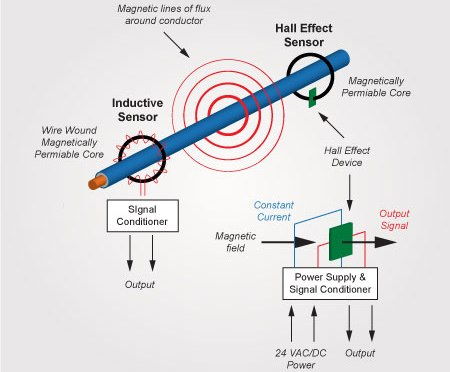
Thus, 1amp of electric current in the measured conductor would produce 0.001 amps or 1milliamp of electric current at the input of the meter. With this technique, much larger currents can exist hands measured by increasing the number of turns in the secondary.
Clamp meters measure whatever combination of alternating and straight electric current. This includes static DC and charging DC too every bit AC. Clamp meters measure DC using Hall effect sensors. A Hall effect sensor, basically a kind of magnetometer, can sense the force of an practical magnetic flux. Unlike a elementary inductive sensor, the Hall upshot sensor volition work when the applied magnetic flux is static, not changing. Information technology will piece of work for alternating magnetic fields besides. A clench meter contains a toroidal atomic number 26 cadre that clamps together with a Hall effect chip in the gap between the two halves so that the induced magnetic flux from the current-carrying wire is channeled through it.

Sponsored ⓘ
What do clamp meters measure?
- Any of these: alternate current, AC and DC voltage, resistance, continuity, and, with some models, direct current, capacitance, temperature, frequency, and more than;
- Typically measure to the nearest 10th of a unit of measurement (rather than the milliunits you find in a full-function multimeter), making them perfect for electrical work.
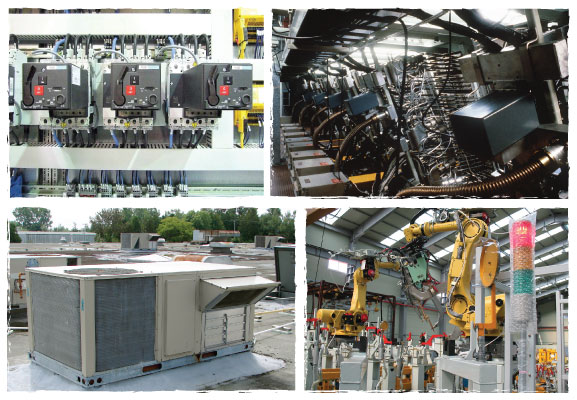
Who uses them?
- Industrial maintenance technicians
- Control technicians
- Residential electricians and contractors
- Facilities, building maintenance, and HVAC technicians
- Service organizations
What are they used on?
- Industrial equipment
- Industrial controls
- Electrical systems
- Commercial/industrial HVAC
What do they apply them for?
- Service: Repairing existing systems on an as-needed ground.
- Installation: Troubleshooting installation bug, performing concluding circuit tests, and supervising apprentice electricians while installing electrical equipment.
- Maintenance: Performing scheduled and preventive maintenance on electro-mechanical systems.
Measurements
Electric current
I of the most bones measurements of a clamp meter is current. Today'south clamp meters are capable of measuring both AC and DC. Typical current measurements are taken on diverse branch circuits of an electrical distribution system. Determining how much current is flowing in various branch circuits is a fairly mutual task for the electrician.
How to make current measurements
- Select Amps Air-conditioning or Amps DC
- Open the jaws of the clamp meter and close the jaws around a unmarried usher.
- View the reading in the display
Past taking current measurements along the run of a branch circuit, you can easily tell how much each load along the branch circuit is drawing from the distribution arrangement. When a circuit breaker or transformer appears to be overheating, it'due south best to take a current measurement on the branch circuit to determine the load current. However, brand sure yous are using a true-RMS responding meter so y'all can get an accurate measurement of the indicate heating up these components. The average responding meter volition not requite a true reading if the current and voltage are nonsinusoidal due to not-linear loads.
Voltage
Some other common office for a clench meter is measuring voltage. Today's clamp meters are capable of measuring both Air-conditioning and DC voltage. Air conditioning voltage is usually created by a generator and and so distributed through an electrical distribution system. An electrician'south chore is to be able to take measurements throughout the organization to isolate and prepare electric problems.
Another mutual voltage measurement would exist testing battery voltage. In this example, you would be measuring direct electric current or DC voltage. Testing for proper supply voltage is usually the first thing measured when troubleshooting a excursion. If in that location is no voltage present, or if it is likewise high or too depression, the voltage problem should be corrected earlier investigating farther.
A clamp meter'south power to measure Ac voltage tin can be affected by the frequency of the signal. About clamp meters can accurately mensurate AC voltages with frequencies from fifty Hz to 500 Hz, simply a digital multimeter'south AC measurement bandwidth might be 100 kHz or higher. This is why the reading of the same voltage past a clamp meter and a digital multimeter tin can have very different results. The digital multimeter allows more of the high-frequency voltage through to the measurement circuitry, while the clamp meter filters out some of the voltage contained in the signal to a higher place the bandwidth of the meter.
When troubleshooting a variable frequency drive (VFD), the input bandwidth of a meter can go very important in getting a meaningful reading. Due to the high harmonic content in the signal coming out of a VFD to the motor, a DMM would measure nigh of the voltage content (depending on its input bandwidth). Measuring the voltage output of a VFD is now a common measurement. A motor connected to a VFD only responds to the average value of the signal, and to mensurate that power, the input bandwidth of the clamp meter must be narrower than its DMM counterpart.
How to make voltage measurements

- Select Volts AC or Volts DC, as desired.
- Plug the black exam probe into the COM-input jack. Plug the red test probe into the V-input jack.
- Touch the probe tips to the circuit beyond a load or power source (in parallel to the circuit).
- View the reading, beingness sure to note the unit.
By taking a voltage measurement at the excursion breaker and then at the input of the load on that breaker, you tin make up one's mind the voltage drop that occurs across the wires connecting them. A significant drop in voltage at the load might impact how well the load functions.
Resistance
Resistance is measured in ohms. Resistance values can vary greatly, from a few milliohms (mΩ) for contact resistance to billions of ohms for insulators. Near clamp meters mensurate down to 0.1ohms. When the measured resistance is college than the upper limit of the meter or the circuit is open, "OL" appears in the meter's display. Resistance measurements are to be fabricated with the circuit power off—otherwise, the meter or circuit could exist damaged. Some clamp meters provide protection in the ohms mode in case of accidental contact with voltages. The level of protection may vary greatly among different clamp meter models.
How to make resistance measurements
- Turn off power to the excursion.
- Select resistance (Ω).
- Plug the black test probe into the COM-input jack. Plug the cerise test probe into the VΩ-input jack.
- Connect the probe tips across the component or portion of the excursion for which you want to determine resistance.
- View the reading in the meter'due south display.
NOTE! Make sure the power is off before making resistance measurements.
Continuity
Continuity is a quick get/no-get resistance test that distinguishes between an open and a closed circuit. A clench meter with a continuity beeper allows you to complete many continuity tests hands and chop-chop. The meter beeps when it detects a airtight circuit, so you don't have to look at the meter as you examination. The level of resistance required to trigger the beeper varies from meter to meter. The typical resistance setting to plow on the beeper is a reading less than between 20 ohms and forty ohms.
Question And Answer
Source: https://megadepot.com/resource/how-to-use-clamp-meters
0 Response to "How to Know It a Clamp Meter Is Reading Volts or Amps"
Post a Comment